
The quick answer: most land problems are expensive, not fatal. A lot with bad soil, no water line, or an awkward setback still gets built on — it just costs more than you planned. Only a few problems genuinely end a deal, and you can identify all of them inside a standard 30-day due-diligence window if you know what to look for.
This is the checklist we walk through before we'll quote a build on a lot a client is considering. If you're asking is my lot buildable — in Guilford, Forsyth, Davidson, or Randolph County — this is how we answer it. It's organized by what you should do about each finding, not by how likely you are to hit it.
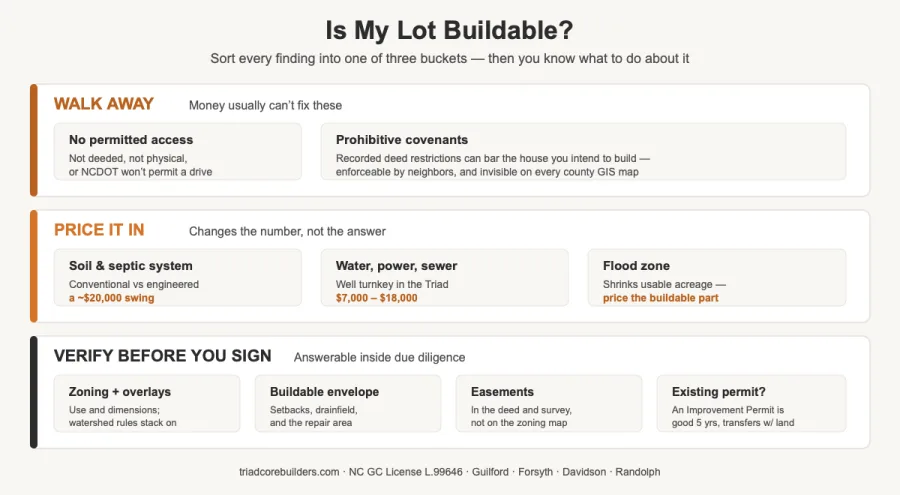
Is my lot buildable? The short version
| What to check | Tier | Why it matters |
|---|---|---|
| Legal + physical + permitted access | Walk away | The only problem money usually can't fix |
| Recorded covenants and deed restrictions | Walk away | Can bar your house outright — invisible on county GIS |
| Zoning district and overlays | Verify | Governs use and dimensions |
| Setbacks and the real buildable envelope | Verify | What's left after every line is drawn |
| Easements crossing the parcel | Verify | Eats buildable area, lives in the deed |
| Existing Improvement Permit | Verify | Valid 5 years, transfers with the land |
| Soil evaluation and septic system type | Price it in | Swings the budget ~$20,000 |
| Flood zone — and how much land it takes | Price it in | Shrinks usable acreage; check the value, not the label |
| Water, power, and sewer runs | Price it in | The line that quietly blows budgets |
Tier 1 — Walk away
These two are the ones we tell clients not to negotiate around.
No permitted access
"Road frontage" gets used as one idea when it's really three, and a lot can pass two of them and still be unbuildable.
Legal access — is there a deeded right to reach the parcel from a public road? A lot with no deeded access is landlocked. Everything else on this page has a price; this one requires a neighbor to agree to sell you an easement. If they won't, your options narrow fast. North Carolina's cartway statute (N.C.G.S. § 136-69 is often mentioned as the fallback, but read what it actually covers: it applies to land used for cultivation, timber, quarries, mines, industrial or manufacturing plants, or a cemetery. Building a house is not on that list. A cartway proceeding is not a general-purpose remedy for a landlocked residential lot, and anyone who tells you otherwise is describing a different statute than the one on the books. Talk to a real estate attorney before you assume a court can hand you access.
Physical access — can a driveway actually be built? A creek crossing, a ravine, or a 30% bank between the road and the buildable area turns access into an engineering project.
Permitted access — can you legally connect a driveway to the road? If the road is state-maintained and you're building on a vacant parcel, the connection goes through NCDOT, and the review looks at sight distance in both directions, drainage and culverts, and the proposed use. Worth knowing: the UNC School of Government notes that NCDOT generally does not require driveway permits for existing single-family residential parcels — so this is a question for raw land and new connections, not for a lot that already has a working drive. On rural two-lane roads with a curve or a crest, sight distance is the piece most likely to complicate a new entrance. Ask the county or NCDOT district office before you assume frontage equals access.
Verify all three before you're emotionally attached to the lot.
Recorded covenants and deed restrictions
This is the one that catches people, because it is invisible everywhere you'd think to look.
Covenants are private restrictions recorded at the Register of Deeds. They are separate from zoning, frequently stricter than zoning, and enforceable by the neighbors regardless of what the county would allow. They routinely dictate minimum heated square footage, exterior materials, roof pitch, whether a detached garage or outbuilding is permitted, and whether an architectural review committee has to approve your plans.
None of that appears on a county GIS map. A lot can be perfectly zoned for a single-family home and still prohibit the specific home you intend to build.
Pull the recorded restrictions for the subdivision or tract during due diligence, and read them against your actual plan — not against "a house."
Tier 2 — Price it in
Everything here changes the number, not the answer. This is also where a builder earns their keep, because these are the items a buyer genuinely cannot price alone.
Soil and the septic system
If the lot has no sewer, the soil decides your septic system, and the system decides a meaningful chunk of your budget.
North Carolina doesn't use percolation tests. People still say "perc test" — we say it too — but the state evaluates soil morphology: a specialist digs into the profile and reads horizon depth, texture, structure, consistence, and color. Our septic and soil evaluation guide covers the whole process, including the three permits and their order.
What it means for the budget:
| System | Cost | When it's required |
|---|---|---|
| Conventional gravity | $5,000 – $10,000 | Good soil (Group I–II), adequate space |
| Low-pressure pipe (LPP) | $6,500 – $8,000 | Marginal soils — common in the Piedmont |
| Engineered (mound, drip, advanced) | $15,000 – $25,000+ | Poor soils, high water table, tight sites |
That's a swing of roughly $20,000 decided entirely by what's under the grass. It's also visible in the county's own fee schedule: in Guilford County a Construction Authorization for a conventional system is $100, while an alternative system authorization is $450, with alternative design review at $550. The permitting cost tracks the system complexity before you've bought a single component.
Guilford charges $100 per bedroom for a residential soil evaluation, so a three-bedroom house is a $300 evaluation. Fees differ by county — call yours before you budget.
Flood zone — price the land you can actually use
Being in a flood zone doesn't end a deal. It changes two things: how much of the lot you can build on, and what the lot is worth to you as a result.
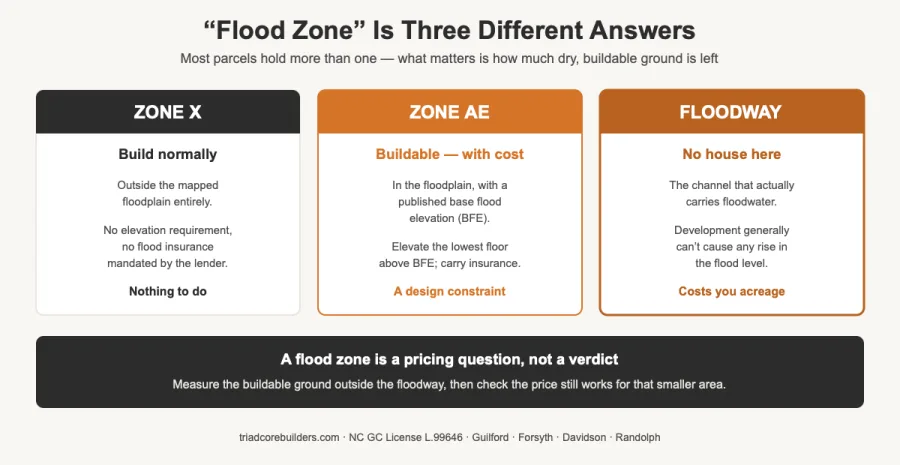
"Is it in a flood zone?" is the wrong question anyway, because the answer covers three very different situations.
Zone X is outside the mapped floodplain. Nothing to do.
Zone AE is in the floodplain with a published base flood elevation. This is buildable — you elevate the lowest floor above the BFE and carry flood insurance. It's a cost and a design constraint, and both are quotable.
The floodway is the channel the water actually moves through during a flood. Development there generally can't cause any rise in the flood level, which in practice means a house doesn't go there.
Here's the part that matters: a parcel is rarely all one thing. Plenty of Triad lots have a creek and a floodway along one edge and perfectly dry, unmapped ground on the rest. The floodway takes acreage out of play — it doesn't take the lot out of play.
So the work isn't to check a box, it's to measure:
- Find the buildable area that sits outside the floodplain. Pull the FEMA flood map against the parcel boundary and see what's actually left on high ground.
- Check that what's left still holds everything. House footprint, driveway, septic drainfield, and the reserved repair area all have to fit in that remaining envelope, inside the setbacks.
- Then run the valuation. If a 5-acre parcel is priced as 5 usable acres but only 2 are buildable, you're overpaying — and that's a negotiation, not an exit. Land with a compressed buildable area should be priced like land with a compressed buildable area.
Sometimes the answer is that the compressed lot is still a good buy: it's cheaper per acre, the creek is an amenity rather than a defect, and the house fits fine on the dry portion. Sometimes the usable ground is too small or too awkward and the number stops working. Either way it's an arithmetic question, not a verdict.
Walk it with someone who can tell you how much of it you can actually build on before you accept the seller's acreage as the thing you're buying.
Water, power, and sewer
This is the item most often mislabeled a deal-killer when it's really a budget line. A lot with no water or sewer main isn't unbuildable — it's a well-and-septic lot, which is normal across rural Guilford, Forsyth, Davidson, and Randolph.
For a well in the Triad, plan on $7,000 to $18,000 turnkey. Drilling is typically $5,000 to $15,000 depending on depth and rock, and the pump, pressure tank, pitless adapter, and tie-in add roughly $2,000 to $4,500. Those figures come from T.W. Stanley & Son, a Greensboro well and pump company operating since 1946 — worth noting they don't drill wells themselves, so their drilling range reflects what they see other contractors charge.
Typical residential wells here run 200 to 500 feet deep. There's a geological reason for that: NC State Extension notes that water "moves more slowly through the denser clay and rock of the piedmont and Blue Ridge regions, so well yields tend to be lower" than in the sandy coastal plain. In the Piedmont you're drilling into bedrock, and you go as deep as you need to for yield.
Budget the permit and testing as well — a Guilford County well construction permit is $450, and the county's water sampling runs about $185 for a standard bacteria and inorganic/nitrate panel including the trip fee.
One scheduling note people miss: after the well is drilled and the pump is set, shock chlorination and the bacteria test add another 24 to 48 hours before the water is approved for drinking.
Where public utilities do exist, the question becomes distance. A water or sewer main several hundred feet away is priced by the foot, and an electrical service extension follows the same logic. This is worth a specific quote rather than an assumption, because it's the line item most likely to quietly consume your contingency.
Slope and site preparation
Grade drives driveway length, foundation type, retaining walls, and how much dirt has to move. A gently rolling lot is unremarkable; a steep one can add real money before the foundation is poured. Walk the lot with someone who will have to build on it.
Tier 3 — Verify before you sign
These aren't usually deal-enders, but each one can change what you're allowed to build, and all of them are answerable during due diligence.
Zoning district and overlays
Start with the base district — it governs whether a single-family home is permitted, and it also sets the dimensional rules. Then check for overlays stacked on top: watershed protection, historic districts, airport overlays, corridor standards. In Randolph and southern Guilford, Randleman Lake watershed rules are the common one, and they carry additional restrictions on impervious surface and buffers.
Zoning is also curable, unlike access. A rezoning, variance, or special use permit is a real path — it's just slow and never guaranteed, so treat it as a plan you'd need extra time and money to execute, not a formality.
Setbacks and the real buildable envelope
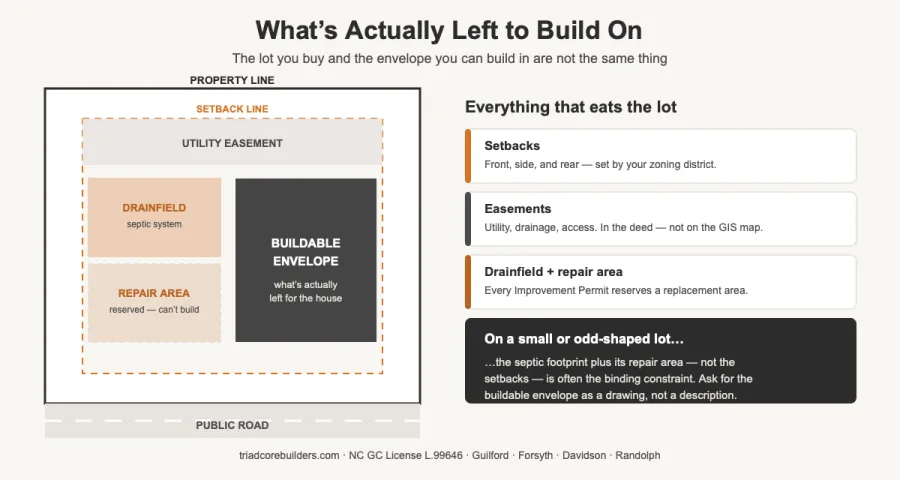
Setbacks come from the same zoning ordinance as use, which is why we treat them as one topic. Front, side, and rear setbacks carve a smaller rectangle out of the lot, and the house has to fit inside it — along with the driveway, the septic drainfield, and the required repair area.
That last piece surprises people, and it's stronger than most buyers realize. North Carolina's rules require a repair area — ground reserved for a replacement drainfield if the first one fails — and 15A NCAC 18E .0508 is blunt about it: "If the site does not have available space for both an initial wastewater system and repair area it shall be unsuitable." That's not a setback you can request a variance from. If both don't fit inside the setbacks, the lot doesn't perc — it fails on space.
There is one narrow exemption, and it won't apply to most land you're shopping: lots recorded on or before January 1, 1983 that are too small to hold a repair area, serving a single-family dwelling at no more than 480 gallons per day. Even then the health department records the maximum feasible repair area on the permit. On a small or oddly shaped lot, the septic footprint plus its repair area is often the binding constraint — not the setbacks.
Ask for the buildable envelope as an actual drawing, not a description.
Easements crossing the parcel
Utility, drainage, and access easements live in the deed and the survey, not on the zoning map. A power easement across the middle of a lot can remove the best building site while leaving the acreage figure untouched. This is one of several reasons a boundary survey — $700 to $1,000 in this market — is money well spent before closing rather than after.
Whether an Improvement Permit already exists
This is the highest-value question on the entire list, and almost no buyer thinks to ask it.
In North Carolina an Improvement Permit is valid for five years and transfers with the land. If a prior owner had the soil evaluated and pulled an IP, that permit may still be good — which means the soil question is already answered, the system type is already known, and you've skipped weeks of county queue.
Two identical-looking lots, one with a live IP and one without, are not equally valuable. Ask the seller, and ask the county.
What this costs to find out
Real due diligence on a Triad lot is a small fraction of what it protects.
| Item | Typical cost |
|---|---|
| Boundary survey | $700 – $1,000 |
| Soil evaluation (Guilford, per bedroom) | $100 |
| Septic Construction Authorization | $100 conventional / $450 alternative |
| Well construction permit (Guilford) | $450 |
| Water sampling panel (Guilford) | ~$185 |
County fees above are Guilford County's published figures and will differ across Forsyth, Davidson, and Randolph — confirm with the county the lot sits in.
Set against a build in the $170 to $230 per square foot range — roughly $310,000 for an 1,800 sq ft home — spending a few thousand dollars to confirm the land supports the house is the cheapest insurance in the project.
How we do this with clients
We walk lots with buyers before they close, at no cost. It takes an hour or two, and it answers the questions above in the order that matters: access first, then soil, then the envelope, then the budget lines.
If the lot works, you get a real number and a real schedule — our build timeline guide explains why starting the septic evaluation early is what keeps a build in the 6-to-10-month range. If it doesn't work, you've learned that for free, before it's your land.
If you're under contract on a lot in Guilford, Forsyth, Davidson, or Randolph County and want a second opinion before your due-diligence period runs out, get in touch — that's the call we'd rather take early than late.
Frequently asked questions
How long do I have to check all this?
North Carolina purchase contracts typically provide a negotiated due-diligence period, commonly around 30 days on land. Start the soil evaluation immediately — it's the item with the longest queue and the biggest budget consequence, and everything else can proceed while you wait on it.
Can a lot be truly unbuildable?
Yes, though it's less common than people fear. The realistic causes are no legal access with no willing neighbor, or soil that won't support any septic system on a lot with no sewer available. A flood zone usually isn't one of them — it shrinks the buildable area rather than eliminating it, which is a pricing problem. Most findings change the price rather than the answer.
Is a boundary survey really necessary if the lot has corner markers?
We recommend one. Markers get moved, fences rarely follow property lines, and a survey is what reveals easements and encroachments that don't appear anywhere else. At $700 to $1,000 it's inexpensive relative to discovering an easement through your building site after closing.
What's the difference between Zone AE and the floodway?
Zone AE is the floodplain with a published base flood elevation — you can build by elevating above it and carrying flood insurance. The floodway is the channel that actually conveys floodwater, where development generally can't cause any rise in flood levels, so a house doesn't go there. Neither one condemns a parcel. What matters is how much buildable ground sits outside the floodway and whether the price reflects that smaller usable area.
Do covenants really override county zoning?
They don't override it, they add to it. Zoning sets what the county permits; recorded covenants are a private agreement that can be stricter, and they're enforceable by other property owners bound by them. You have to satisfy both, so the more restrictive one controls.
Does a failed soil evaluation mean I can't build?
Usually not. It means the lot needs a different system — low-pressure pipe or an engineered system — which raises cost rather than eliminating the house. The important thing is learning it before closing so it's reflected in what you pay for the land.
Should I get a builder involved before I buy the land?
That's the argument for this whole checklist. A builder is looking at access, grade, soil, the buildable envelope, and the utility runs simultaneously, and pricing them as one project. Most of what's on this page is invisible to a buyer walking a pretty piece of land on a Saturday.
---
Narayanan Bakthisaran · Triad Core Builders · NC Licensed General Contractor L.99646 · Building in Guilford, Forsyth, Davidson & Randolph Counties