
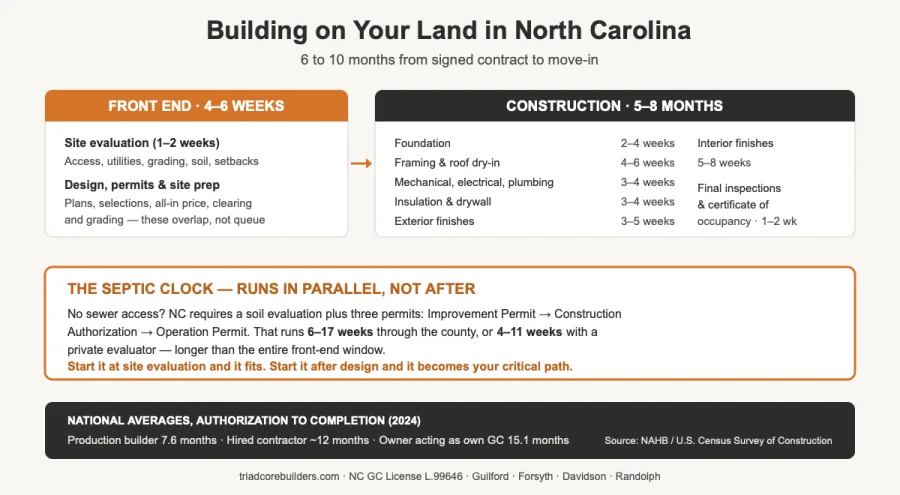
The quick answer: how long it takes to build a house in North Carolina is 6 to 10 months from signed contract to move-in for a build-on-your-land home in the Triad — about 4 to 6 weeks up front for design, permitting, and site prep, then 5 to 8 months of construction from permit approval to certificate of occupancy.
You'll see "6 to 12 months" quoted a lot, and national averages run longer than that. Here's what the timeline actually looks like when you own the land, phase by phase, plus the one scheduling decision that matters more than all the others combined.
Why national averages run longer than our builds
The Census Bureau's Survey of Construction tracks how long homes actually take, and the National Association of Home Builders breaks it down by who does the building. For homes completed in 2024:
| Type of build | Authorization to completion |
|---|---|
| Built for sale (production builder) | 7.6 months |
| Built by a hired contractor | ~12 months |
| Built for rent | ~12.5 months |
| Built by the owner acting as their own GC | 15.1 months |
| All single-family average | 9.1 months |
Source: NAHB analysis of U.S. Census Bureau Survey of Construction data, published September 2025.
Two things worth pulling out of that table.
Owner-built homes take the longest — 15.1 months. If you're weighing acting as your own general contractor to save money, that's the schedule cost: roughly five extra months versus a contractor-built home, on top of managing every trade yourself.
Contractor-built homes average about 12 months nationally, and we run ahead of that. Not because we cut corners, but because we build the same house types with the same trade crews in the same four counties. A builder juggling one-off custom projects in unfamiliar jurisdictions spends weeks on things we've already solved.
One more useful figure: homes between 1,200 and 3,999 sq ft finish at about the average pace, while homes over 5,000 sq ft stretch to 14–16 months. A typical 1,800 sq ft Triad home isn't a schedule outlier.
How long to build a house in North Carolina: the timeline, phase by phase
Durations below are what we plan for on Triad build-on-your-land projects. Every lot is different — you get a real schedule after the site evaluation, not a brochure number.
Phase 1 — Site evaluation and feasibility (1 to 2 weeks)
Before anything else, we need to know what the land supports: access, utilities, grading, soil, flood zone status, setbacks. On rural lots, this is also when the septic conversation starts — and starting it here rather than later is the single most important scheduling decision in the whole project. More on that below.
This phase is fast, it's free, and it's the highest-leverage part of the build. A lot that won't support the house you want is far better discovered in week one than in month five.
Phase 2 — Design, permitting, and site prep (4 to 6 weeks)
Design, plan selection, final selections, permit applications, and site preparation all live here — and critically, they overlap rather than queue.
You either start from our floor plan library or bring your own design, then we adapt it to the land and your budget. While plans are being finalized, permit applications go in. While permits are in review, clearing and grading begin. Site prep runs 2 to 5 weeks on its own, but most of it happens inside this window rather than after it.
This is also where finishes get locked and you receive a detailed all-in price with the line items walked through. It's the last moment before construction commits, and the cheapest possible time to change your mind.
The septic clock — why it has to start in Phase 1
If your lot has no sewer access, North Carolina requires a soil evaluation and a three-permit sequence: Improvement Permit, then Construction Authorization, then the Operation Permit after inspection. That sequence runs 6 to 17 weeks through the county, or 4 to 11 weeks using a private Authorized On-Site Wastewater Evaluator. The full breakdown is in our septic and soil evaluation guide.
Read those numbers against a 4-to-6-week front end and the math looks impossible. It isn't — but only because the septic clock runs in parallel, not in sequence. We start the soil evaluation at the site-evaluation stage, before plans are drawn, so the permit queue advances while design happens.
Start septic late and it stops being a parallel task. It becomes the critical path, and it can add two to four months to a build that would otherwise have moved on schedule. This is the most common reason build-on-your-land timelines slip, and it's almost entirely avoidable.
Financing runs in parallel here too — construction loan approval typically takes 4 to 8 weeks and requires complete plans plus a signed contract, which is why we recommend starting the construction loan conversation early rather than after plans are final.
Phase 3 — Construction (5 to 8 months)
From permit approval to certificate of occupancy, roughly in order:
| Stage | Typical duration |
|---|---|
| Foundation | 2–4 weeks |
| Framing and roof dry-in | 4–6 weeks |
| Mechanical, electrical, plumbing rough-in | 3–4 weeks |
| Insulation and drywall | 3–4 weeks |
| Exterior finishes | 3–5 weeks |
| Interior finishes, cabinets, flooring, paint | 5–8 weeks |
| Final inspections and certificate of occupancy | 1–2 weeks |
These overlap — exterior work continues while interiors progress — which is why the total is 5 to 8 months rather than the sum of the parts. Sequencing that overlap correctly is most of what a project manager does. You get weekly photo updates throughout, and site visits are always welcome.
Phase 4 — Walkthrough and closing (1 to 2 weeks)
We walk the home with you, build a punch list, and address items before closing. Then keys, warranty package, appliance manuals, and maintenance guide.
We follow up at 30 days, 6 months, and 11 months — the last deliberately timed so anything under the one-year warranty gets caught while it's still covered.
What actually delays Triad builds
In order of how often we see it:
- A septic evaluation started late. The county queue is outside anyone's control. Starting it at site evaluation keeps it parallel; starting it after design makes it the critical path.
- Design indecision. Every revision round after permits are filed has a schedule cost. Deciding thoroughly up front beats deciding quickly and revising later.
- Weather. Grading and foundation work stop in sustained rain. A wet spring can absorb a couple of weeks.
- Change orders during construction. Moving a wall in month four means re-inspections and re-sequenced trades.
- Long-lead selections. Certain windows, appliances, and cabinet lines still carry long lead times in 2026. We flag these during selections so they're ordered before they're needed.
Notice that four of the five are decided before construction starts. Schedules are mostly won or lost in the first six weeks, not on the job site.
How to keep your build on schedule
- Get the site evaluation done before you close on land — or before finalizing plans, if you already own it.
- If you're unsewered, start the soil evaluation immediately. It's the longest pole, and it only stays off your critical path if it starts early.
- Consider a private AOWE rather than the county queue when timing matters; it typically saves 2 to 6 weeks.
- Start financing early. Approval takes 4 to 8 weeks and gates your start date.
- Lock selections and mean it. The biggest schedule lever you personally control.
- Ask about long-lead items during selections, not after.
Frequently asked questions
How long does it take to build a house in North Carolina?
For a home built on your own land in the Triad, plan on 6 to 10 months from signed contract to move-in — about 4 to 6 weeks for design, permitting, and site prep, then 5 to 8 months of construction. Nationally, Census data puts contractor-built homes at about 12 months from authorization to completion; we run ahead of that by building repeatable house types with consistent crews in four counties we know well.
Why do some builders quote 6 months?
Production builders on pre-permitted subdivision lots genuinely finish that fast — Census data puts built-for-sale homes at 7.6 months. Building on your own land involves site-specific engineering and permitting that a subdivision lot has already been through.
Does a septic system make the build take longer?
Only if it starts late. The NC soil evaluation and three-permit sequence runs 6 to 17 weeks through the county, or 4 to 11 weeks with a private evaluator — longer than the entire front-end window. It fits because we start it at the site-evaluation stage, so the permit clock runs alongside design instead of after it. Start it late and it can add two to four months.
Would I save time acting as my own general contractor?
No — the data says the opposite. Census figures put owner-built homes at 15.1 months versus about 12 for contractor-built, roughly five extra months, plus you're managing every trade, inspection, and permit yourself.
What's the longest phase of building a house?
Construction itself, at 5 to 8 months. But the phase most likely to delay you is permitting, because its duration depends on queues you don't control.
Does weather stop construction in the Triad?
It stops specific phases. Grading, foundation, and exterior work are weather-dependent; interior work continues regardless. A wet spring typically costs a couple of weeks, which is why we build float into the schedule rather than quoting a best case.
When should I contact a builder?
Before you buy land, ideally. A site evaluation costs nothing and can tell you whether a lot supports the home you have in mind — much cheaper to learn before closing than after. Our land due-diligence checklist walks through everything worth confirming during the due-diligence window.
---
Own land in Greensboro, High Point, Winston-Salem, Lexington, or nearby? We'll walk your lot, tell you what it supports, and give you a real schedule instead of a range. Start with a free site evaluation, try our cost estimator, or get in touch — call 336-509-2640.
Narayanan Bakthisaran · Triad Core Builders · NC Licensed General Contractor L.99646 · Building in Guilford, Forsyth, Davidson & Randolph Counties