
The quick answer: if the land you're buying in North Carolina doesn't have sewer access, do not close until the soil has been evaluated for a septic system. A conventional septic system in the Triad runs about $5,000–$10,000. If the soil fails to support one, an engineered system runs $15,000–$25,000 — and in rare cases the lot can't support a home at all. Ten minutes of due diligence before closing protects you from the most expensive surprise in land buying.
At Triad Core Builders, we do a free site evaluation on every build-on-your-land project in Guilford, Randolph, Davidson, and Forsyth counties — and septic is the first thing we check on any rural lot. Here's how a perc test in North Carolina actually works, what a septic system costs, and everything else we look at, with real numbers.
The perc test in North Carolina — what the state actually does (it's better)
Everyone in North Carolina still says "perc test," and we use the phrase ourselves. But here's something most land listings won't tell you: North Carolina's septic rules don't use percolation tests. The name stuck; the procedure didn't.
A traditional perc test poured water into a hole and timed how fast it drained. The problem: it measured what the soil did on one day, in one kind of weather. A dry July afternoon and a wet March morning could give the same lot opposite results.
What NC uses instead is a soil morphology evaluation. The statewide rule (15A NCAC 18E .0501, effective January 1, 2024) requires the evaluator to investigate topography and landscape position, soil morphology — horizon depth, texture, structure, consistence, and color — soil wetness condition, soil depth, restrictive horizons, and available space. Soil profiles are evaluated on site "by borings, pits, or other means of excavation." The word percolation does not appear anywhere in the rule.
Soil color alone reveals seasonal wetness that a one-day water test would completely miss. The evaluation classifies your soil into Group I (sandy, well-drained) through Group IV (dense clay) — a permanent characteristic of the land, not a snapshot of the weather.
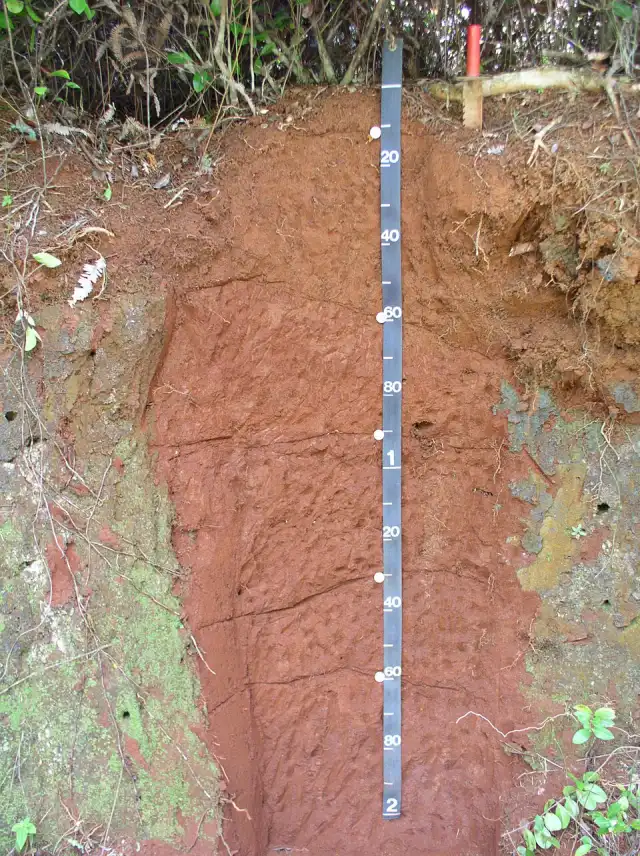
A soil profile like the evaluator sees it — deep red clay, measured horizon by horizon. Photo: USDA NRCS (public domain).
Why this matters to you as a buyer: the soil group determines what kind of septic system the lot needs, and that single fact can swing your budget by $20,000. Soil is one item on a longer list — our land due-diligence checklist covers the rest of what to verify before closing.
What the Piedmont's red clay means for your lot
Our region sits in North Carolina's Piedmont, famous for its red clay. Clay drains slowly — which means septic drain fields here need to be sized generously, and some sites need more than a conventional gravity system.
The good news: a soil evaluation almost never comes back "unbuildable." Even Group III and IV soils can usually support some system type — it's a question of which one, and what it costs:
| System type | Typical cost (NC, 2026) | When it's needed |
|---|---|---|
| Conventional gravity | $5,000 – $10,000 | Good soil (Group I–II), adequate space |
| Low-pressure pipe (LPP) | $6,500 – $8,000 | Marginal soils — common in the Piedmont |
| Engineered (mound, drip, advanced) | $15,000 – $25,000+ | Poor soils, high water table, tight sites |
These are the same numbers we use in our cost-to-build guide — our typical 1,800 sq ft budget carries $18,000 for a conventional well-and-septic setup, and an engineered septic system can add $10,000–$15,000 over conventional. Nothing about a "failed" evaluation kills a project by itself; it just changes the budget, and you want to know that before the land is yours, not after.
The three permits every NC septic system needs
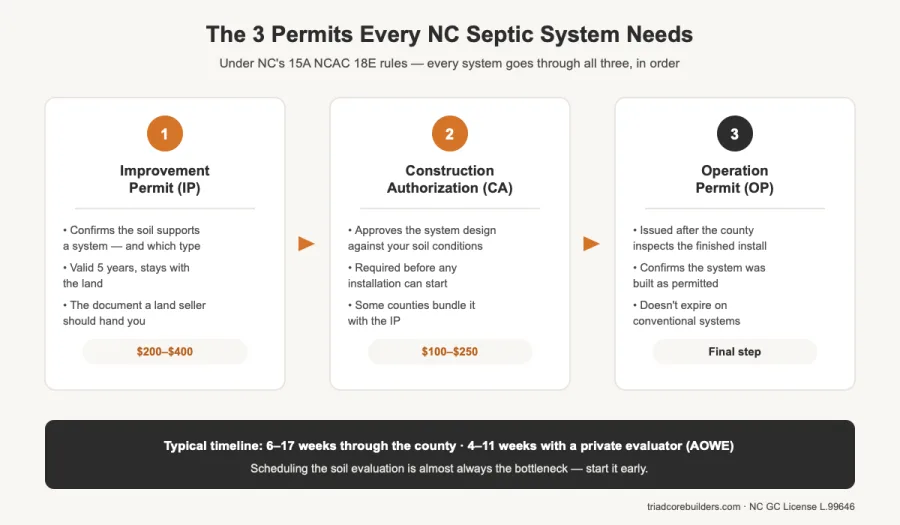
North Carolina runs on-site wastewater through a three-permit sequence under the state's 15A NCAC 18E rules (overhauled January 2024 — the biggest update in three decades). Every system goes through all three, in order:
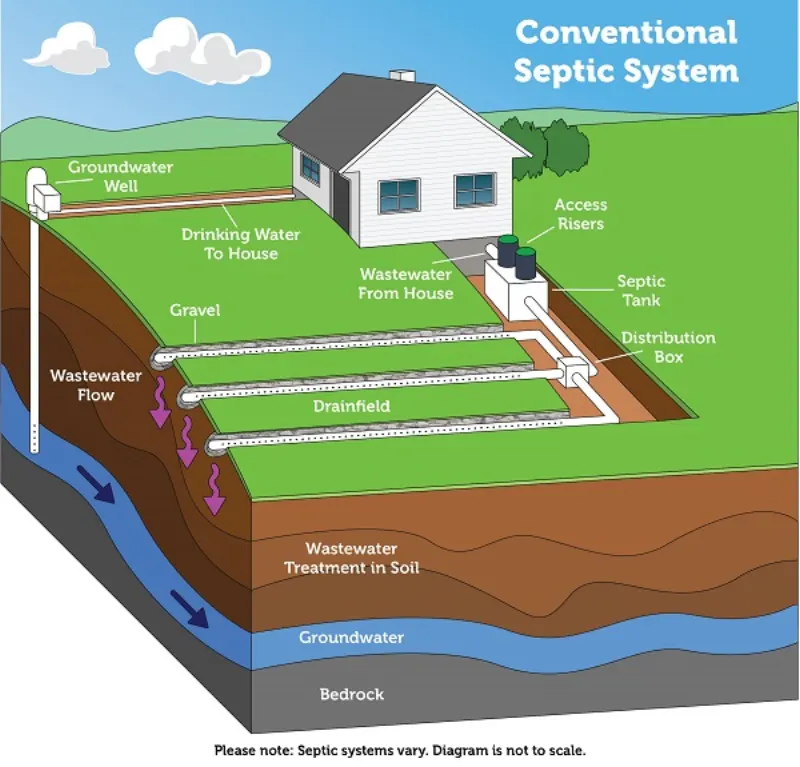
A conventional septic system: house to tank to drainfield. Diagram: U.S. EPA (public domain).
1. Improvement Permit (IP). The starting point — it confirms the soil can support a system and specifies what type. This is the document that comes out of the soil evaluation. An IP is valid for 5 years and stays with the land.
2. Construction Authorization (CA). The actual build permit. System design — tank size, drain field layout — gets reviewed against the soil conditions in the IP. No installation can legally start without it.
3. Operation Permit (OP). Issued after the county inspects the finished installation. For conventional systems it doesn't expire.
For land buyers, the Improvement Permit is gold. A seller who can hand you a current IP has already answered the biggest question about the lot. No IP? Then the burden — and the risk — is on you to get the soil evaluated before you commit. It's fair to make your offer contingent on a satisfactory soil evaluation; sellers of legitimate buildable lots rarely object.
What it costs and how long it takes
Realistic numbers for the evaluation-and-permit side (the system installation itself is the table above):
| Item | Typical cost | Notes |
|---|---|---|
| County soil evaluation + Improvement Permit | $200 – $400 | Through your county health department |
| Private evaluator (AOWE) | $300 – $800 | Optional — skips the county queue, saves weeks |
| Construction Authorization | $100 – $250 | Some counties bundle with the IP |
| Engineering design (complex sites only) | $200 – $2,500+ | Steep slopes, poor soil, tight lots |
Timeline is the part that surprises people: from first application to a finished, permitted system typically runs 6–17 weeks through the county, or 4–11 weeks using a private evaluator. The bottleneck is almost always scheduling the soil evaluation — busy counties can be backed up several weeks. This is why we start the septic conversation at the site-evaluation stage, before plans are even drawn: it keeps the permit clock running in parallel instead of holding up construction. Our build timeline guide shows exactly where this fits against the rest of the schedule — and what it costs you if it starts late.
One more planning detail: NC sizes septic systems at 120 gallons per day per bedroom. A 3-bedroom home needs 360 GPD of capacity; a 4th bedroom pushes it to 480. If you think you might add bedrooms later, size the system for them now — upsizing afterward means going back through permitting.
The five septic mistakes that cost land buyers real money
1. Closing without a soil evaluation. The big one. If the lot has no sewer and no Improvement Permit, an evaluation is the cheapest insurance you'll ever buy — a few hundred dollars against a five-figure surprise.
2. Building over the repair area. Every Improvement Permit designates a repair area — ground reserved for a replacement drain field decades from now. Pouring a driveway, shed, or pool over it is a classic mistake: when the original field eventually wears out, there's nowhere legal to put its replacement.
3. Assuming a small lot can hold a system. Setbacks from wells, property lines, and streams all constrain where a drain field can go. A lot can have fine soil and still fail on geometry. This is part of what we check in a site evaluation.
4. Counting bedrooms wrong. That "office" you plan to convert someday is a bedroom in the county's eyes. Permit capacity follows bedroom count — get it right up front.
5. Hiring an uncertified installer. Every septic installer in NC must be certified by the state's On-Site Wastewater Board (NCOWCICB), and homeowner self-installs aren't legal. An unpermitted system will surface at resale — usually at the worst possible moment.
City lot instead? Different math
On lots served by municipal utilities in Greensboro, High Point, or Winston-Salem, the whole septic question disappears — replaced by water and sewer tap and connection fees. Those are usually cheaper than a well-and-septic setup, but they vary by city and by how far the mains run from your lot. Before we quote a city-lot build, we confirm both with the city — "sewer nearby" and "sewer available to your parcel" are not always the same thing.
Frequently asked questions
How much does a perc test (soil evaluation) cost in NC?
Through your county health department, the soil evaluation is included in the Improvement Permit application — typically $200–$400 total. A private Authorized On-Site Wastewater Evaluator (AOWE) runs $300–$800 and can save several weeks of waiting.
How much does a septic system cost in North Carolina?
About $5,000–$10,000 for a conventional system in the Triad. Marginal soils that need a low-pressure pipe system run $6,500–$8,000, and engineered systems (mound, drip, advanced treatment) run $15,000–$25,000 or more.
What happens if land fails the soil evaluation?
Lots rarely "fail" outright — the evaluation determines which system types the soil supports. Poor soils usually mean a more expensive engineered system rather than no system. Truly unbuildable lots exist but are the exception, which is exactly why you evaluate before you close.
How long is an NC Improvement Permit good for?
Five years from issuance, and it can be renewed if site conditions haven't changed. A current IP transfers with the land — for buyers, it's the single most valuable document a land seller can provide.
Can I install my own septic system in NC?
No. North Carolina requires all septic installation, modification, and repair work to be done by state-certified contractors. Unpermitted work creates liability and will surface during a future sale.
Looking at land? Let us walk it with you — free.
Before you commit to a lot in Guilford, Forsyth, Davidson, or Randolph County, we'll evaluate it free: soil and septic feasibility, access, utilities, and what the site means for your total build budget. No pressure, no obligation — just the answers you need before closing. Call 336-509-2640 or request your free site evaluation online. And for the full picture, start with our 2026 cost-to-build guide and our construction loan guide — buildable land plus the right financing is how the project actually starts.
Narayanan Bakthisaran · Triad Core Builders · NC Licensed General Contractor L.99646 · Building in Guilford, Forsyth, Davidson & Randolph Counties