
The quick answer: most people who build on their own land in North Carolina use a construction-to-permanent loan — one closing, one set of fees, interest-only payments while the house goes up, then it converts automatically into a normal mortgage. If you own your land outright, its value typically counts as some or all of your down payment — which is how some of our clients finance 100% of construction cost without writing a down-payment check. Investors and borrowers who need speed have additional routes, from government-backed programs to hard money lenders — all covered below.
Financing is the part of building that intimidates people most, and it's genuinely less complicated than it looks once someone walks you through the moving parts. Here's the same explanation we give clients at the kitchen table, with real 2026 numbers.
Why you can't just get a mortgage
A mortgage lends against a house that exists. When you're building, there's no house yet — so lenders use a different tool: a short-term construction loan that pays out in stages as the house gets built, then gets replaced by (or converts into) a regular mortgage when the home is finished.
That stage-by-stage payout is called a draw schedule. A typical build has 4–6 draws tied to milestones:
| Draw | Milestone | Typical share of loan |
|---|---|---|
| 1 | Foundation complete | 10–15% |
| 2 | Framing and roof complete | 20–25% |
| 3 | Plumbing/electrical/HVAC rough-in | ~20% |
| 4 | Drywall and exterior complete | ~20% |
| 5 | Substantial completion | ~15% |
| Final | Certificate of occupancy | 5–10% |
After each milestone, the lender sends an inspector to confirm the work is done, then releases the funds. You pay interest only on what's been drawn — not the full loan amount. Early in the build, your interest payments are small; they grow as the house does.
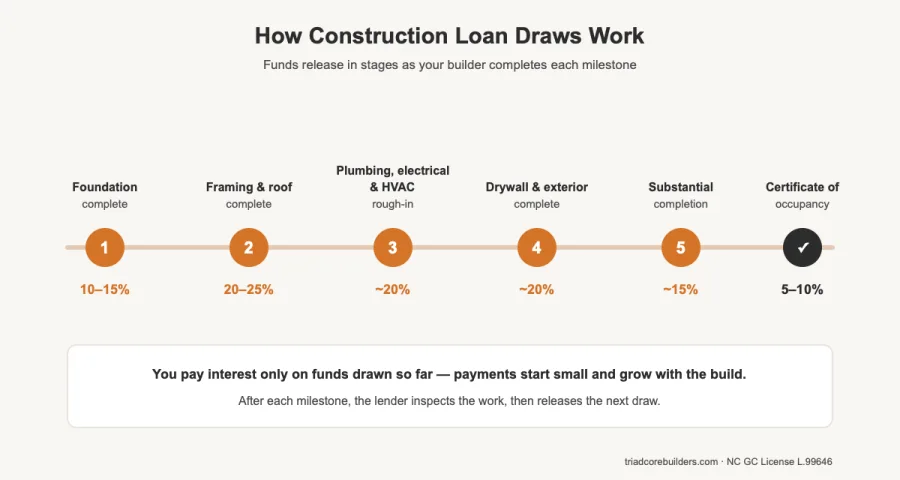
This is also why your builder matters to your lender: the draw schedule sets the rhythm of the whole project. A builder who hits milestones predictably keeps draws — and subcontractor payments — flowing on schedule. (More on builder approval below.)
One closing or two: construction-to-permanent vs. standalone
Construction-to-permanent (C2P, "one-time close") — one loan, one closing, one set of closing costs. Your permanent mortgage terms are set before ground breaks, and the loan converts automatically when the house is done. Under the current Fannie Mae single-close rules, the construction period fits within 12 months (18 months total) — comfortably ahead of a typical 5–8 month build.
Standalone construction loan ("two-time close") — a construction loan first, then a separate permanent mortgage when the home is complete. Two applications, two closings, roughly $3,000–$8,000 in extra closing costs — in exchange for the flexibility to shop the permanent rate at the end of the build.
| Construction-to-permanent | Standalone | |
|---|---|---|
| Closings (and closing costs) | One | Two |
| Rate certainty | Set before you break ground | Unknown until the build ends |
| Typical 2026 rate (construction phase) | ~7.25%–8.75% | ~7.75%–9.25% |
| Best for | Most owner-land builds | Rate optimists, unusual timelines |
Our take: C2P is the right default for most build-on-your-land clients. One closing is cheaper and simpler, and knowing your permanent rate before you commit removes the biggest financial unknown from the project. The standalone route is a bet that rates will drop meaningfully during your build — if you'd rather not gamble your mortgage rate on a prediction, take the certainty.
For context: construction loans price above regular mortgages (the lender is financing a house that doesn't exist yet). Mid-2026, the benchmark 30-year fixed sits around 6.5%, while construction phases run in the 7s and 8s. The construction-phase rate only applies for the months of the build — then you're into normal mortgage territory.
The land-equity advantage: how 100% financing happens
Here's the part that surprises people most, and it's the single biggest financial advantage of already owning land.
Construction lenders typically want 20–25% down. But "down payment" doesn't have to mean cash — land equity counts. If you own your lot outright, the lender counts its appraised value toward your equity in the project.
Run the numbers on our typical 1,800 sq ft build (~$310,000): if you own land worth $60,000–$80,000 — an inherited acre, a lot you bought years ago — your land alone covers a ~20–25% equity requirement. Result: the lender finances 100% of the construction cost, and you write little or no down-payment check. Some of our clients have started construction with essentially no cash out of pocket beyond design fees and deposits.
Even land you're still paying off can help — many one-time-close programs pay off a lot loan as part of the construction financing.
And when the house is done, the math usually compounds in your favor: a $310,000 build on land you own frequently appraises well above its combined cost the day you move in. You start homeownership with built-in equity instead of a decade of payments to reach it.
What lenders look for in 2026
Realistic qualification picture for a construction loan:
- Credit score: most lenders want 680+; 720+ earns the better rates
- Debt-to-income: total debts, including the future mortgage payment, within roughly 43–45% of gross income
- Down payment / equity: 20–25% of project cost — cash, land equity, or both
- Complete plans and a signed builder contract — lenders underwrite against final documents; late redesigns reopen underwriting
- An "as-completed" appraisal — the lender values the finished home from the plans, and lends against that number
And one requirement people don't expect: the lender approves your builder, not just you. License, insurance, financial stability, track record. This is worth reframing as a feature — it's a free layer of due diligence on whoever you're about to trust with the biggest purchase of your life. A licensed builder with a clean record and lender relationships sails through; this is also one honest reason to be cautious about the cheapest unlicensed quote on Facebook Marketplace.
Budget note from our cost guide: interest during construction is a real project cost. On a ~$300,000 loan drawn over a 5–8 month build at 2026 rates, plan for roughly $10,000–$20,000 in construction-phase interest depending on draw timing — money to budget up front, not discover later.
Government-backed routes worth knowing
For the right situation, three programs change the math:
- USDA construction loans — for homes in USDA-eligible rural areas (which includes much of Randolph and Davidson counties), a single-close USDA loan can reach zero down payment for qualifying incomes. Fewer lenders offer them, but they exist and we've seen them work.
- VA one-time close — veterans and active-duty service members can finance construction with $0 down and no PMI. If you've served, ask about this one first.
- FHA one-time close — lower down payment (3.5%) and more forgiving credit requirements, traded for mortgage insurance and some added process.
These programs have more paperwork and fewer participating lenders than conventional C2P — the trick is finding a loan officer who actually does them regularly rather than one who's learning on your file.
Hard money loans: the fast, expensive option
There's one more financing route worth knowing about, mostly used by investors: hard money construction loans from private lenders.
A hard money lender underwrites the deal, not primarily the borrower — the loan is secured by the property and its as-completed value, with far less weight on your W-2s, tax returns, and debt-to-income ratio. In exchange, you pay for the convenience:
- Rates around 10–13% in 2026 — several points above bank construction loans
- Origination points of 1–3% of the loan amount, paid up front
- Short terms — typically 6–18 months, with real penalties if the project runs long
- Fast closings — often 1–2 weeks instead of the 4–8 weeks a bank takes
When hard money makes sense: investors building spec homes or rentals who need speed and volume; self-employed borrowers whose tax returns understate their real income; borrowers with a strong project but a credit profile banks won't touch; and situations where a deal dies without a two-week close. For our multifamily and investment clients, hard money is a normal tool of the trade — the higher carrying cost is just a line item in the deal's math.
When it doesn't: for most families building a home to live in, hard money is the expensive detour. On a $300,000 build, the rate-and-points difference versus a bank construction loan can add $15,000–$25,000 to the project — money that buys a lot of countertops. If you can qualify for a conventional C2P or a government-backed program, do that instead. Hard money is a speed-and-flexibility premium, and you should only pay it when speed or flexibility is actually what the project needs.
One more caution: private lending is lightly regulated compared to banks. If you go this route, vet the lender like you'd vet a builder — verified closed projects, clear fee sheet in writing, and references from borrowers who've completed (not just started) projects with them.
Own land? Here's how financing works with a GC — house, duplex, or multifamily
If you own a lot and you're deciding what to put on it, the financing picture changes with what you build — and this is where working with a licensed general contractor from day one pays for itself. Here's the map:
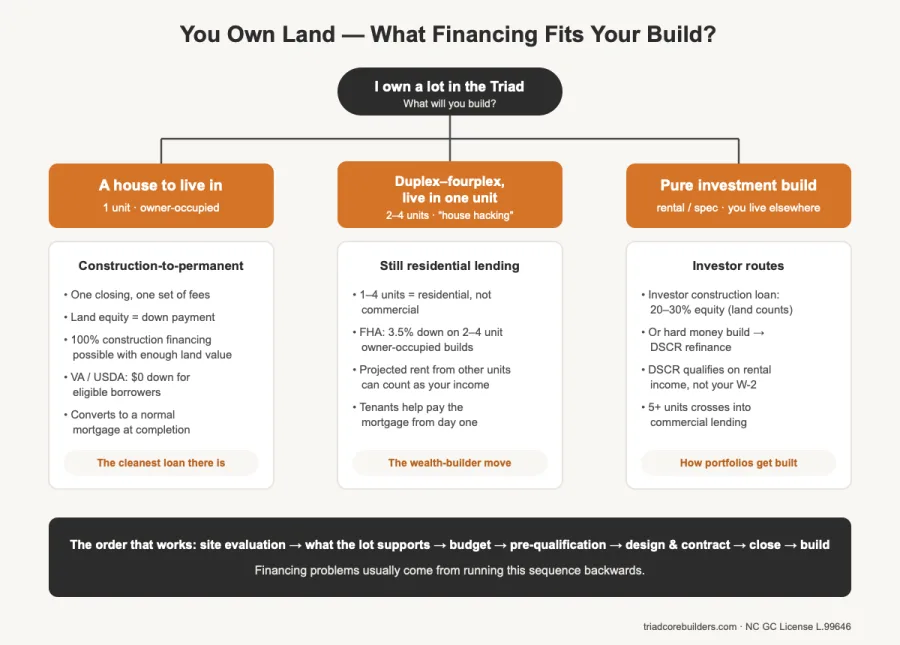
Building a house to live in. The construction-to-permanent path described above, with your land as the down payment. This is the cleanest financing in this article — 1-unit, owner-occupied, every lender's favorite loan.
Building a duplex, triplex, or fourplex you'll live in. Here's the option too few landowners know: 1–4 unit properties still count as residential, so they qualify for the same residential financing as a house — not commercial lending. Live in one unit and rent the rest ("house hacking"), and owner-occupied programs apply: FHA finances 2–4 unit owner-occupied properties at 3.5% down, VA can do it for veterans, and conventional owner-occupied multifamily programs exist too. Better still, lenders can often count a portion of the projected rent from the other units as qualifying income — the future duplex helps pay for itself in underwriting. A duplex on land you own, financed with land equity, where a tenant covers most of your mortgage, is one of the strongest wealth-building moves in residential real estate.
Building purely as an investment (you won't live there). Two main routes: an investor construction loan from a local bank (typically stricter — expect 20–30% equity, and your land counts toward it), or a hard money loan into a DSCR refinance — build with short-term financing, then refinance into a DSCR loan, which is underwritten on the property's rental income rather than your personal income. DSCR is how investors scale past the point where their W-2 stops impressing underwriters. For 5+ units you cross into commercial lending — different world, and worth a conversation before you design something that's harder to finance than it needs to be. We build duplexes, quadplexes, and small multifamily for investors across the Triad, and the financing conversation is part of every project's planning phase.
How a GC actually helps you get financed
People assume the builder shows up after the loan. In practice, the right GC is part of getting the loan:
- A lender-credible fixed-price contract. Lenders underwrite against a signed construction contract with a licensed, insured builder. A vague bid from an unlicensed crew isn't financeable; a complete contract from a licensed GC is. Our license (#L.99646), insurance, and track record are documents your lender will ask for — and having them ready shortens approval.
- A budget the appraiser can defend. The "as-completed" appraisal drives your loan amount. A detailed line-item budget and complete plans give the appraiser something solid to value — undersupported appraisals come in low, and low appraisals shrink loans.
- A draw schedule that matches how we actually build. We've been through lender draw inspections many times; a schedule aligned with real milestones means funds release on time and subs stay paid — no mid-project cash crunches.
- Lender introductions. We work with local lenders who close construction loans in the Triad every week — including on 2–4 unit projects — and we're glad to make the introduction. A loan officer who already knows the builder moves faster than one starting cold.
- Feasibility before you're committed. The free site evaluation tells you what the land supports — septic capacity and zoning can decide whether your lot can legally hold a duplex at all — before you spend money on plans a lender won't fund or a project the county won't permit.
The order of operations that works: site evaluation → what the lot supports → realistic budget → lender pre-qualification → design and contract → loan closing → build. Financing problems usually come from running that sequence backwards.
How to set your build up for smooth financing
- Talk to a construction lender before you finalize plans. Pre-qualification tells you your real budget — better to design a $310K house you can finance than a $450K house you can't.
- Use local lenders. Community banks and credit unions in the Triad often keep construction loans on their own books, which means more flexible underwriting and better terms than the national megabanks. We work with local lenders who close these loans every week and are glad to make an introduction.
- Get plans and contract finalized before applying. Loan approval typically takes 4–8 weeks; complete documents are what keep it at 4.
- Build your contingency into the loan. Add the cushion at closing rather than hoping change orders squeeze into the budget later — going back for more money mid-build is slow and expensive.
- Start the perc test and permits early. Lenders need the site to be buildable; a lot without septic approval can stall underwriting. Site feasibility and financing should move in parallel.
Frequently asked questions
What are construction loan rates in 2026?
Construction-to-permanent loans are running roughly 7.25%–8.75% and standalone construction loans 7.75%–9.25%, depending on lender and credit profile — above the ~6.5% benchmark 30-year mortgage because the lender is financing a home that isn't built yet. The construction-phase rate applies only during the build.
Can I use my land as the down payment for a construction loan?
Yes — this is standard practice. If you own your land outright, its appraised value counts toward the lender's 20–25% equity requirement. Own enough land value and the lender finances 100% of construction cost. Land with a remaining lot loan can often be rolled into the construction financing.
What credit score do I need to build a house?
Most construction lenders want a 680 minimum, with the best terms at 720+. Government-backed programs (FHA, VA, USDA) can be more flexible on credit but add their own requirements.
What is a hard money construction loan?
A short-term loan from a private lender, underwritten on the property's as-completed value rather than primarily on your income and credit. Expect 10–13% rates plus 1–3 points in 2026, 6–18 month terms, and closings in as little as 1–2 weeks. It's a standard tool for investors and self-employed borrowers, but usually the expensive choice for an owner-occupied build if you qualify for bank financing.
Can I build a duplex or fourplex on my land with a residential loan?
Yes — 1–4 unit properties are residential in the lending world. If you live in one unit, owner-occupied programs apply (FHA from 3.5% down, VA for veterans), and lenders can often count projected rent from the other units toward your qualifying income. Pure investment builds use investor construction loans or hard-money-into-DSCR structures. Five or more units means commercial financing.
How much is the down payment on a construction loan?
Typically 20–25% of total project cost — but land equity counts toward it. Cash-poor, land-rich is a genuinely strong position for building. VA and USDA programs can reach 0% down for eligible borrowers; FHA one-time close runs 3.5%.
Do I pay my mortgage while the house is being built?
On a construction-to-permanent loan you make interest-only payments during construction — and only on the funds drawn so far, so payments start small and grow with the build. The full principal-and-interest mortgage payment begins after the loan converts at completion.
Find out what your build — and your financing — really look like
The first step isn't a bank application; it's knowing what your project actually costs on your land. We'll evaluate your site free, give you a written all-in estimate, and introduce you to local lenders who close construction loans every week. Call 336-509-2640 or request your free site evaluation online. New to the numbers? Start with our 2026 cost-to-build guide and the land buyer's septic guide.
Narayanan Bakthisaran · Triad Core Builders · NC Licensed General Contractor L.99646 · Building in Guilford, Forsyth, Davidson & Randolph Counties